MMMU-Pro benchmark leaderboard: testing multimodal AI for visual understanding
Updated: Mar 27
Ever wondered which AI model is best at understanding images?
The MMMU-Pro benchmark is one of the better tests we have for this.
It measures multimodal skill on real, messy, expert-level questions. The kind that include diagrams, tables, charts, and screenshots.

Why should you care?
This is not an “image caption” test. It is a reasoning benchmark.
For multimodal AI, it is one of the best proxies we have for:
visual understanding you can trust
combining text + images correctly
solving real-world diagram problems
fewer confident wrong answers
So if your work involves reports, engineering docs, medical scans, or technical visuals, MMMU-Pro scores actually matter.
Not sure which AI model to pick?
Read our full guide to the best LLMs
Best LLM on the MMMU-Pro benchmark (leaderboard)
The MMMU-Pro benchmark shows something important:
Multimodal reasoning is improving fast…
But it is still not solved.
The top tier is tightening
GPT-5.4 and Gemini 3 Pro now share the top spot at 81%.
That tie matters. It suggests the frontier models are starting to converge on similar performance when it comes to visual reasoning.
Right behind them sits Qwen 3 at 77%, followed by Claude Opus 4.6 at 74%.
At this level, the question is no longer “can the model understand images?”
It becomes:
How consistently can it reason over complex visuals like diagrams, charts, and technical documents?
The middle tier drops quickly
Below the leaders, performance falls noticeably.
Ernie 5.0 lands at 65%
Grok 4 scores 63%
Llama 4 Maverick comes in at 62%
These models can handle many multimodal tasks, but they tend to struggle more often on the hardest visual reasoning problems.
For workflows that rely heavily on diagrams, technical screenshots, or structured documents, that gap becomes very visible.
Mistral falls behind
Mistral scores 56%
That places it well behind the frontier models.
Vision remains a capability where only the top models compete.
What is the MMMU benchmark?
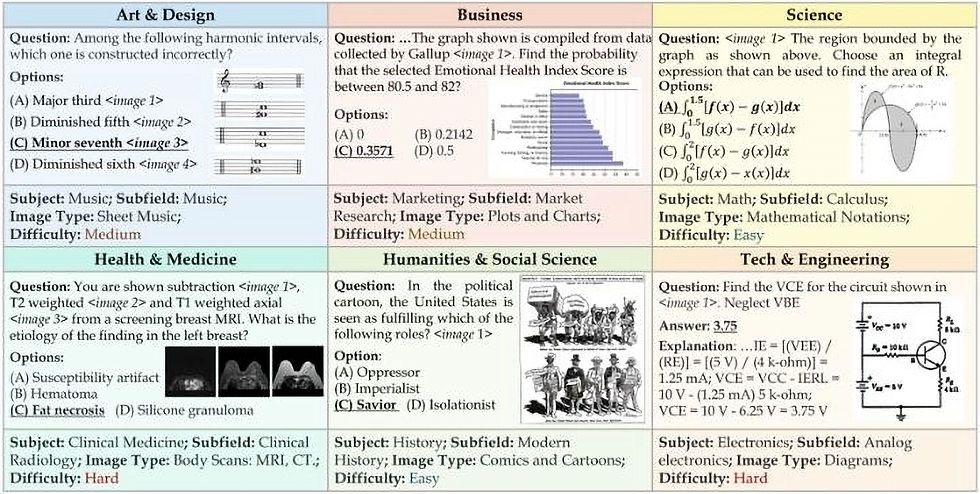
MMMU stands for Massive Multi-discipline Multimodal Understanding and Reasoning.
It was introduced by Yue et al. (2024) to evaluate multimodal models on expert-level tasks that integrate text and images.
The benchmark includes 11.5K college-level questions sourced from:
exams
quizzes
textbooks
Covering six disciplines:
art and design
business
science
health and medicine
humanities and social science
tech and engineering
Unlike simpler vision tests, MMMU focuses on deep reasoning, not just perception.
What is the MMMU-Pro benchmark?
MMMU-Pro is the upgraded version.
It was introduced to make the benchmark harder and more realistic.
The key idea:
Modern models were starting to saturate MMMU
So MMMU-Pro adds more challenging visual setups
For example:
noisy backgrounds
real-world formatting
harder document-style questions
It is closer to what multimodal AI faces in business and research settings.
MMMU-Pro is now one of the best benchmarks left for testing true visual reasoning.
Ready to apply AI to your work?
Benchmarks are useful, but real business impact is about execution.
We run hands-on AI workshops and build tailored AI solutions, fast.


Comments